Australia Baby Incubators Market Size & Outlook, 2026-2034
Australia Baby Incubators Market Insights
- Deep Market Insights analysis indicates that the Australia Baby Incubators Market size, valued at USD 14.31 Million in 2025, is expected to expand to USD 24.01 Million by 2034.
- The Australia market is forecasted to expand at a CAGR of 5.87% spanning 2026–2034.
- Conventional/standard incubators held the leading position among By Product Type segments in 2025, based on market size.
- Conventional/standard incubators is projected to post the fastest growth rate, sustaining its position as the most attractive By Product Type segment during the forecast horizon.
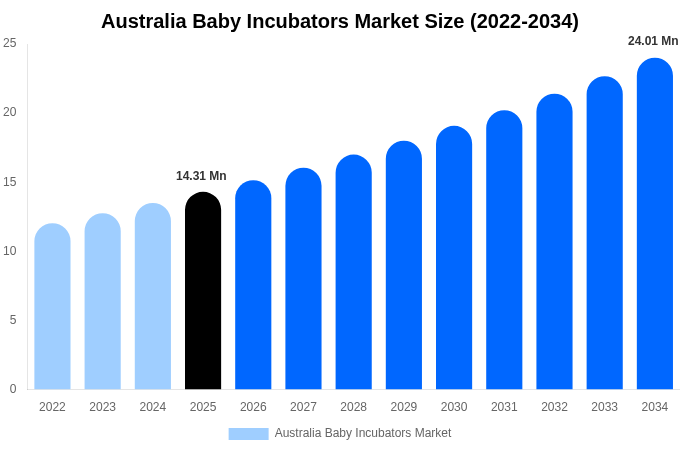
Source: DMI Analysis Company Publications, Primary Interviews.

Other Key Findings
- In 2025, Australia accounted for 1.75% of the global Baby Incubators Market size.
- By 2034, United States is expected to lead the global Baby Incubators Market in terms of market size.
- Within Asia Pacific, China is projected to dominate the regional Baby Incubators Market size by 2034.
- China is identified as the fastest-growing market in Asia Pacific, anticipated to reach USD 168.88 Million by 2034.
Report Summary
| Report Scope | Details |
|---|---|
| Base Year for Study | 2025 |
| Study Period | 2022-2034 |
| Historical Period | 2022-2024 |
| Forecast Period | 2026-2034 |
| Market Size In 2025 | USD 14.31 Million |
| Market Size In 2034 | USD 24.01 Million |
| Largest segment | Conventional/standard incubators |
| Units | Revenue in USD Million |
| CAGR | 5.87% (2026-2034) |
| Segmnetation Covered | |
| By Product Type |
|
| By Type |
|
| By Application |
|
| By End-User |
|
| By Technology |
|
| Report Coverage | Revenue Forecast, Competitive Landscape, Growth Factors, Environment & Regulatory Landscape and Trends |
Australia Baby Incubators Market By Product Type 2026-2034 (USD Million)
| By Product Type | 2022 | 2023 | 2024 | 2025 | 2026 | 2027 | 2028 | 2029 | 2030 | 2031 | 2032 | 2033 | 2034 |
|---|---|---|---|---|---|---|---|---|---|---|---|---|---|
| Conventional/standard incubators | XX.x | XX.x | XX.x | 7.59 | XX.x | XX.x | XX.x | XX.x | XX.x | XX.x | XX.x | XX.x | XX.x |
| Transport/portable incubators | XX.x | XX.x | XX.x | XX.x | XX.x | XX.x | XX.x | XX.x | XX.x | XX.x | XX.x | XX.x | XX.x |
| Hybrid incubators | XX.x | XX.x | XX.x | XX.x | XX.x | XX.x | XX.x | XX.x | XX.x | XX.x | XX.x | XX.x | XX.x |
| Total | XX.x | XX.x | XX.x | XX.x | XX.x | XX.x | XX.x | XX.x | XX.x | XX.x | XX.x | XX.x | XX.x |
Source: DMI Analysis Company Publications, Primary Interviews.
Australia Baby Incubators Market By Type 2026-2034 (USD Million)
| By Type | 2022 | 2023 | 2024 | 2025 | 2026 | 2027 | 2028 | 2029 | 2030 | 2031 | 2032 | 2033 | 2034 |
|---|---|---|---|---|---|---|---|---|---|---|---|---|---|
| Open incubators | XX.x | XX.x | XX.x | 6.86 | XX.x | XX.x | XX.x | XX.x | XX.x | XX.x | XX.x | XX.x | XX.x |
| Closed incubators | XX.x | XX.x | XX.x | XX.x | XX.x | XX.x | XX.x | XX.x | XX.x | XX.x | XX.x | XX.x | XX.x |
| Double-walled incubators | XX.x | XX.x | XX.x | XX.x | XX.x | XX.x | XX.x | XX.x | XX.x | XX.x | XX.x | XX.x | XX.x |
| Total | XX.x | XX.x | XX.x | XX.x | XX.x | XX.x | XX.x | XX.x | XX.x | XX.x | XX.x | XX.x | XX.x |
Source: DMI Analysis Company Publications, Primary Interviews.
Australia Baby Incubators Market By Application 2026-2034 (USD Million)
| By Application | 2022 | 2023 | 2024 | 2025 | 2026 | 2027 | 2028 | 2029 | 2030 | 2031 | 2032 | 2033 | 2034 |
|---|---|---|---|---|---|---|---|---|---|---|---|---|---|
| Neonatal hypothermia and low birth weight | XX.x | XX.x | XX.x | 7.77 | XX.x | XX.x | XX.x | XX.x | XX.x | XX.x | XX.x | XX.x | XX.x |
| Jaundice treatment | XX.x | XX.x | XX.x | XX.x | XX.x | XX.x | XX.x | XX.x | XX.x | XX.x | XX.x | XX.x | XX.x |
| Genetic disorders and others | XX.x | XX.x | XX.x | XX.x | XX.x | XX.x | XX.x | XX.x | XX.x | XX.x | XX.x | XX.x | XX.x |
| Total | XX.x | XX.x | XX.x | XX.x | XX.x | XX.x | XX.x | XX.x | XX.x | XX.x | XX.x | XX.x | XX.x |
Source: DMI Analysis Company Publications, Primary Interviews.
Australia Baby Incubators Market By End-User 2026-2034 (USD Million)
| By End-User | 2022 | 2023 | 2024 | 2025 | 2026 | 2027 | 2028 | 2029 | 2030 | 2031 | 2032 | 2033 | 2034 |
|---|---|---|---|---|---|---|---|---|---|---|---|---|---|
| Hospitals | XX.x | XX.x | XX.x | 7.87 | XX.x | XX.x | XX.x | XX.x | XX.x | XX.x | XX.x | XX.x | XX.x |
| Neonatal Intensive Care Units | XX.x | XX.x | XX.x | XX.x | XX.x | XX.x | XX.x | XX.x | XX.x | XX.x | XX.x | XX.x | XX.x |
| Pediatric and maternity clinics | XX.x | XX.x | XX.x | XX.x | XX.x | XX.x | XX.x | XX.x | XX.x | XX.x | XX.x | XX.x | XX.x |
| Total | XX.x | XX.x | XX.x | XX.x | XX.x | XX.x | XX.x | XX.x | XX.x | XX.x | XX.x | XX.x | XX.x |
Source: DMI Analysis Company Publications, Primary Interviews.
Australia Baby Incubators Market By Technology 2026-2034 (USD Million)
| By Technology | 2022 | 2023 | 2024 | 2025 | 2026 | 2027 | 2028 | 2029 | 2030 | 2031 | 2032 | 2033 | 2034 |
|---|---|---|---|---|---|---|---|---|---|---|---|---|---|
| Conventional incubators | XX.x | XX.x | XX.x | 6.57 | XX.x | XX.x | XX.x | XX.x | XX.x | XX.x | XX.x | XX.x | XX.x |
| Smart/IoT-enabled incubators | XX.x | XX.x | XX.x | XX.x | XX.x | XX.x | XX.x | XX.x | XX.x | XX.x | XX.x | XX.x | XX.x |
| AI-integrated monitoring systems | XX.x | XX.x | XX.x | XX.x | XX.x | XX.x | XX.x | XX.x | XX.x | XX.x | XX.x | XX.x | XX.x |
| Total | XX.x | XX.x | XX.x | XX.x | XX.x | XX.x | XX.x | XX.x | XX.x | XX.x | XX.x | XX.x | XX.x |
Source: DMI Analysis Company Publications, Primary Interviews.