Kitesurf Kites Market Size
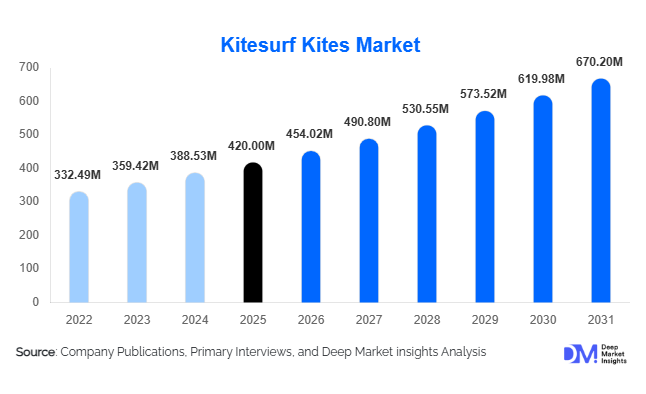
According to Deep Market Insights, the global Kitesurf Kites Market was valued at approximately USD 420 million in 2025 and is projected to reach around USD 454.02 million in 2026. Over the forecast period (2026–2031), the market is expected to expand further to nearly USD 670.20 million by 2031, growing at a CAGR of 8.1%. The market expansion is driven by increasing participation in adventure water sports, rising coastal tourism activities, and continuous innovation in kite design technologies, including lightweight composite materials, hybrid kite structures, and improved wind-control systems.
Growing interest in experiential outdoor recreation among millennials and Gen Z consumers is significantly boosting demand for kitesurfing equipment globally. Additionally, the expansion of kitesurfing schools, rental operators, and professional training academies is lowering entry barriers for new users, further strengthening market penetration. Europe continues to dominate consumption, while Asia-Pacific is emerging as the fastest-growing region due to rapid tourism infrastructure development and rising disposable incomes.
Key Market Insights
- LEI (Leading Edge Inflatable) kites dominate global adoption due to ease of use, safety, and suitability for beginners and intermediate riders.
- Freeride and recreational kitesurfing represent the largest usage segment, supported by tourism-driven participation and training schools.
- Europe remains the largest regional market, driven by strong coastal sports culture in Spain, France, and the Netherlands.
- Asia-Pacific is the fastest-growing region, fueled by tourism expansion in Thailand, Vietnam, China, and Australia.
- Online distribution channels are rapidly expanding, although specialty offline retail still dominates due to product testing preferences.
- Technological advancements in kite materials such as ripstop nylon and carbon-reinforced structures are improving durability and performance.
Kitesurf Kites Market Trends
Lightweight and High-Performance Material Innovation
Manufacturers are increasingly focusing on developing ultra-lightweight kites using advanced ripstop nylon, carbon reinforcements, and hybrid canopy structures. These innovations improve flight stability, wind responsiveness, and durability under extreme conditions. The trend is particularly strong in premium product categories where performance optimization is a key differentiator. Enhanced material engineering is also helping reduce kite weight, making it easier for beginners to handle while improving agility for professional riders.
Expansion of Kitesurfing Tourism and Training Ecosystems
The growth of coastal tourism and water sports academies is significantly influencing market expansion. Governments and private operators are investing in kitesurfing schools, rental hubs, and training infrastructure in regions such as Southeast Asia, Southern Europe, and Latin America. This ecosystem development is increasing first-time participation rates and driving consistent demand for entry-level kites, rental fleets, and mid-range equipment.
Kitesurf Kites Market Drivers
Rising Popularity of Adventure Water Sports
The increasing global preference for adventure and experiential tourism is a major driver of the kitesurf kites market. Younger consumers are actively seeking high-adrenaline outdoor activities, and kitesurfing has emerged as one of the fastest-growing water sports globally. Social media exposure and influencer-driven travel content are further accelerating participation rates, boosting equipment sales across recreational and professional segments.
Growth of Coastal Tourism Infrastructure
Significant investments in coastal tourism infrastructure are supporting market growth. Countries across Europe, Asia-Pacific, and the Middle East are developing beach resorts, water sports zones, and training centers. These developments are increasing accessibility to kitesurfing, particularly for beginners and tourists, thereby expanding the consumer base for kitesurf kites globally.
Technological Advancements in Kite Design
Continuous innovation in kite aerodynamics, depower systems, and hybrid kite configurations is improving user experience and safety. Modern kites offer better wind range adaptability, easier relaunch mechanisms, and enhanced control systems, making the sport more accessible to a wider audience and driving repeat purchases among enthusiasts.
Kitesurf Kites Market Restraints
High Equipment and Training Costs
Kitesurf kites and associated equipment remain relatively expensive, limiting adoption in price-sensitive markets. Additional costs such as training programs, safety gear, and travel to suitable locations further increase the total cost of participation, restricting market penetration in emerging economies.
Dependence on Weather and Wind Conditions
The sport is highly dependent on consistent wind conditions, which limits usability in many regions and seasons. This dependency reduces utilization rates for rental operators and creates seasonal demand fluctuations, impacting revenue stability for manufacturers and service providers.
Kitesurf Kites Market Opportunities
Expansion in Emerging Coastal Tourism Markets
Rapid development of tourism infrastructure in regions such as Southeast Asia, the Middle East, and Latin America presents significant growth opportunities. Governments are promoting beach tourism and adventure sports, creating demand for rental fleets, training schools, and beginner-friendly equipment. This expansion is expected to unlock new customer bases for manufacturers.
Development of Eco-Friendly and Sustainable Kites
Increasing environmental awareness is driving demand for recyclable materials and sustainable production methods. Manufacturers investing in eco-friendly canopy fabrics and low-emission manufacturing processes are likely to gain competitive advantage, particularly in Europe where sustainability regulations are strong.
Growth of Rental and Subscription-Based Models
The rising popularity of rental services and subscription-based sports equipment access is creating recurring revenue opportunities. Tourists and beginners prefer renting high-cost equipment rather than purchasing, enabling operators to scale usage across multiple customers and improving market penetration in tourism-heavy regions.
Report Scope
| Report Metric | Details |
|---|---|
| Market Size in 2025 | USD 420 Million |
| Market Size in 2026 | USD 454.02 Million |
| Market Size in 2031 | USD 670.20 Million |
| CAGR | 8.1% (2026-2031) |
| Base Year for Estimation | 2025 |
| Historical Data | 2022-2024 |
| Forecast Period | 2026-2031 |
| Report Coverage | Revenue Forecast, Competitive Landscape, Supply Chain Disruption, Growth Factors, Environment & Regulatory Landscape and Trends |
| Geographies Covered | North America, Europe, APAC, Middle East and Africa, LATAM |
| Countries Covered | U.S., Canada, U.K., Germany, France, Spain, Italy, Russia, Nordic, Benelux, Rest of Europe, China, Korea, Japan, India, Australia, Singapore, Taiwan, South East Asia, Rest of Asia-Pacific, UAE, Turky, Saudi Arabia, South Africa, Egypt, Nigeria, Rest of MEA, Brazil, Mexico, Argentina, Chile, Colombia, Rest of LATAM |
Explore more data points, trends and opportunities Download Free Sample Report
Product Type Insights
Leading Edge Inflatable (LEI) kites dominate the global Kitesurf Kites Market, accounting for the largest share of overall demand due to their superior stability, safety, and ease of relaunch in varied wind conditions. Their dominance is primarily driven by their suitability for beginners and intermediate riders, which represents the largest user base globally. LEI kites also benefit from strong adoption in training schools and rental fleets, where durability and ease of use are critical purchase criteria. Continuous improvements in depower systems and inflatable bladder durability have further strengthened their market leadership position.
Foil kites are gaining increasing traction among advanced riders and hydrofoil enthusiasts due to their superior aerodynamic efficiency, lightweight construction, and exceptional performance in low-wind conditions. This segment is primarily driven by the rising popularity of hydrofoil kitesurfing, particularly in Europe and Australia, where variable wind conditions require high-efficiency kite systems. Foil kites also benefit from growing demand in competitive racing applications where speed optimization is critical.
Hybrid kites, which combine characteristics of both LEI and foil designs, represent a niche but fast-evolving segment. Growth in this category is driven by demand from versatile riders who require multi-condition adaptability and reduced equipment dependency. Manufacturers are increasingly investing in hybrid designs to target premium consumers seeking performance flexibility across freeride, wave, and light-wind environments.
Application / Riding Style Insights
Freeride kites represent the largest application segment in the Kitesurf Kites Market, driven by their balanced performance, ease of control, and suitability for recreational users. This segment benefits strongly from tourism-driven participation and training school adoption, where beginners prioritize safety and ease of learning over high-performance features. Freeride kites are also widely preferred in rental fleets, making them the backbone of volume demand globally.
Freestyle kites are primarily driven by the expanding competitive kitesurfing ecosystem, including international events, sponsorship-backed athletes, and professional training academies. Their demand is supported by increasing youth participation in extreme sports and the growing influence of social media-driven stunt and trick-based content.
Wave riding kites are experiencing steady growth, particularly in coastal surfing destinations across Europe, Australia, and Latin America. This segment is driven by the convergence of surfing and kitesurfing cultures, where riders seek enhanced maneuverability in ocean wave conditions. Racing and hydrofoil kites represent the fastest-growing high-performance niche, supported by technological innovation and rising interest in speed-based competitive formats.
Distribution Channel Insights
Offline specialty sports retailers continue to dominate the distribution landscape due to strong consumer preference for physical product evaluation, expert consultation, and trial-based purchasing. This channel is particularly important for first-time buyers who require guidance on wind compatibility, size selection, and safety features. The dominance of offline retail is further reinforced by kitesurfing schools and regional distributors bundling equipment sales with training services.
Online retail channels are expanding rapidly, driven by improved product accessibility, transparent pricing, and increasing digital penetration among younger consumers. Direct-to-consumer strategies adopted by leading brands are accelerating this shift, enabling better margins and stronger customer engagement. However, high-value premium buyers still often rely on hybrid purchasing models combining online research with offline consultation.
Direct sales through brand-owned platforms and kitesurfing clubs are also growing, particularly in premium and professional segments where customization, advanced specifications, and performance tuning are required. Subscription-based rental and seasonal usage models are emerging as additional distribution pathways in tourism-heavy regions.
End-User Insights
Recreational users and beginners constitute the largest consumer base in the Kitesurf Kites Market, primarily driven by the expansion of coastal tourism and water sports education programs. This segment benefits from increased accessibility through rental services and structured training academies, which significantly lower entry barriers for first-time participants.
Professional athletes represent a smaller but high-value segment, characterized by demand for advanced performance kites optimized for speed, control, and aerodynamic efficiency. Growth in this segment is driven by international competitions, sponsorship ecosystems, and increasing standardization of professional kitesurfing events.
Training schools and rental operators are emerging as one of the most influential institutional buyers, driving bulk procurement of durable and beginner-friendly kites. Their demand is strongly linked to tourism cycles, coastal infrastructure development, and rising participation rates in adventure sports across emerging economies.
Explore more data points, trends and opportunities Download Free Sample Report
Kitesurf Kites Market Segmentations
By Product Type
- Leading Edge Inflatable (LEI) Kites
- Foil Kites
- Hybrid Kites
By Application / Riding Style
- Freeride Kites
- Freestyle Kites
- Wave Riding Kites
- Racing & Hydrofoil Kites
By End User
- Recreational Users / Beginners
- Intermediate Riders
- Professional Athletes
- Training Schools & Rental Operators
By Distribution Channel
- Offline Specialty Sports Stores
- Online Retail / E-commerce Platforms
- Direct-to-Consumer Brand Sales
- Kitesurfing Clubs & Rental Networks
By Material Technology
- Ripstop Nylon Kites
- Polyester Canopy Kites
- Carbon-Reinforced Composite Kites
Regional Insights
North America
North America holds a significant share of the Kitesurf Kites Market, driven by strong participation in coastal regions such as California, Florida, and Hawaii. The region’s growth is primarily supported by high disposable incomes, strong adventure sports culture, and expanding professional kitesurfing communities. Additional growth drivers include increasing investment in coastal recreation infrastructure, rising popularity of experiential tourism, and strong presence of organized water sports events that encourage equipment adoption.
Europe
Europe remains the largest regional market, supported by ideal wind conditions and a deeply embedded water sports culture in countries such as Spain, France, Germany, and the Netherlands. Market growth is driven by well-developed coastal tourism infrastructure, high participation in recreational sports, and strong sustainability awareness among consumers. Increasing adoption of eco-friendly equipment and government-backed tourism initiatives promoting coastal sports are further strengthening regional demand.
Asia-Pacific
Asia-Pacific is the fastest-growing region in the Kitesurf Kites Market, led by China, Thailand, Vietnam, and Australia. Growth is primarily driven by rapid expansion of coastal tourism infrastructure, rising disposable incomes, and increasing adoption of adventure sports among younger demographics. Government investments in beach tourism development, along with the emergence of kitesurfing schools and rental hubs in Southeast Asia, are significantly accelerating market penetration.
Latin America
Latin America, particularly Brazil and Mexico, is witnessing steady growth due to extensive coastlines, consistent wind conditions, and rising international tourism. Market expansion is driven by increasing inbound adventure tourism, affordability compared to other regions, and growing popularity of surf-kitesurf hybrid sports. Brazil, in particular, is emerging as a key global hotspot due to its strong competitive kitesurfing community and favorable natural conditions.
Middle East & Africa
The Middle East & Africa region is emerging as a high-potential market, driven by luxury tourism expansion in the UAE and infrastructure development in South Africa, Egypt, and Morocco. Growth is supported by government initiatives to diversify tourism economies, increasing investment in beachfront resorts, and rising participation in premium adventure sports. The UAE is becoming a regional hub for water sports tourism, while African coastal destinations benefit from natural wind conditions and growing international tourist inflows.
Key Players in the Kitesurf Kites Market
- Duotone (Boards & More)
- Cabrinha
- Naish International
- North Kiteboarding
- F-One
- Slingshot Sports
- Airush
- Ozone Kites
- Core Kiteboarding
- Flysurfer
- Liquid Force
- RRD (Roberto Ricci Designs)
- Gaastra Kiteboarding
- Best Kiteboarding
- Eleveight