Hiking Backpacks Market Size
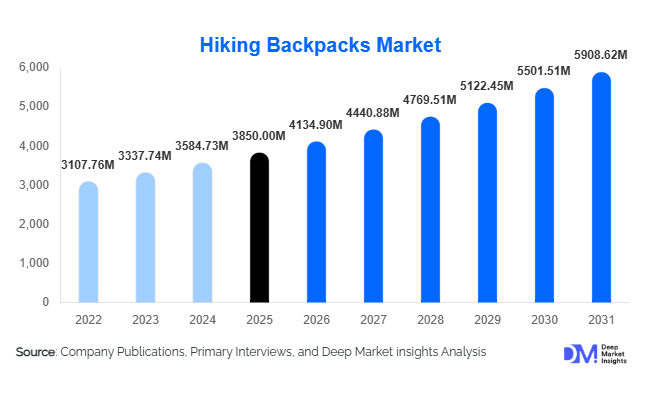
According to Deep Market Insights, the global hiking backpacks market size was valued at USD 3,850 million in 2025 and is projected to grow from USD 4,134.90 million in 2026 to reach USD 5,908.62 million by 2031, expanding at a CAGR of 7.4% during the forecast period (2026–2031). The hiking backpacks market growth is primarily driven by the increasing popularity of outdoor recreational activities, rising health consciousness, and the expansion of adventure tourism globally. Growing participation from millennials and Gen Z consumers, coupled with increasing disposable incomes in emerging economies, is further accelerating demand for lightweight, durable, and ergonomically designed backpacks.
Key Market Insights
- Recreational hiking continues to dominate demand, accounting for nearly 40% of total usage due to increasing weekend travel and outdoor fitness trends.
- Mid-range backpacks lead the pricing segment, contributing approximately 46% of total market share, balancing affordability and performance.
- North America dominates the global market, supported by a strong outdoor culture and an established retail infrastructure.
- Asia-Pacific is the fastest-growing region, driven by rising middle-class income and expanding domestic tourism in countries like India and China.
- Sustainability is becoming a key purchase driver, with growing demand for recycled materials and eco-friendly manufacturing processes.
- E-commerce is reshaping distribution, accounting for nearly 38% of global sales through direct-to-consumer and online retail channels.
What are the latest trends in the hiking backpacks market?
Sustainable and Eco-Friendly Backpack Designs
Environmental sustainability is becoming a defining trend in the hiking backpacks market. Manufacturers are increasingly adopting recycled materials such as ocean plastics and sustainable fabrics like recycled nylon and polyester. Brands are also introducing circular economy initiatives, including repair services and take-back programs, to extend product life cycles. Consumers, particularly in North America and Europe, are showing a strong preference for environmentally responsible products, influencing companies to adopt transparent supply chains and eco-certifications. This trend is expected to significantly shape product innovation and brand positioning over the coming years.
Integration of Smart and Functional Features
Technological advancements are transforming traditional backpacks into multifunctional gear. Smart backpacks equipped with solar charging panels, GPS tracking systems, hydration monitoring, and anti-theft features are gaining traction. Modular designs allowing users to customize compartments for different activities, such as hiking, travel, and commuting, are also emerging. These innovations are particularly appealing to tech-savvy consumers and adventure enthusiasts seeking enhanced functionality and convenience during outdoor activities.
What are the key drivers in the hiking backpacks market?
Growth in Adventure Tourism
The rapid expansion of the global adventure tourism industry, valued at over USD 350 billion in 2025, is a key driver for hiking backpack demand. Popular trekking destinations across North America, Europe, and Asia are witnessing increased footfall, driving demand for high-performance backpacks designed for multi-day and expedition use. Organized trekking tours and government investments in eco-tourism infrastructure are further supporting market growth.
Rising Health and Wellness Awareness
Increasing awareness of physical fitness and mental well-being has led to a surge in outdoor recreational activities such as hiking and trekking. Urban populations are increasingly adopting hiking as a low-cost and accessible fitness activity, driving demand for entry-level and mid-range backpacks. This shift is particularly prominent post-pandemic, where consumers prefer outdoor activities over indoor alternatives.
What are the restraints for the global market?
Price Sensitivity in Emerging Markets
High-quality hiking backpacks often come at premium prices, limiting adoption in price-sensitive regions such as parts of Asia, Africa, and Latin America. Local manufacturers offering low-cost alternatives create pricing pressure, making it challenging for global brands to maintain margins while expanding market reach.
Seasonal Demand Fluctuations
The hiking backpacks market experiences strong seasonality, with peak demand during the summer and holiday seasons. This leads to inventory management challenges for manufacturers and retailers, resulting in fluctuating revenues and operational inefficiencies.
What are the key opportunities in the hiking backpacks industry?
Expansion in Emerging Markets
Emerging economies such as India, China, and Brazil present significant growth opportunities due to increasing disposable incomes and rising participation in outdoor activities. Market penetration remains relatively low, allowing global and regional players to expand distribution networks and introduce region-specific products tailored to local preferences.
Smart Backpack Innovation
The integration of advanced technologies such as solar charging, GPS tracking, and anti-theft systems offers opportunities for product differentiation. Companies investing in smart and multifunctional backpacks can attract premium customers and expand their product portfolios into adjacent categories such as travel and urban mobility.
Report Scope
| Report Metric | Details |
|---|---|
| Market Size in 2025 | USD 3850 Million |
| Market Size in 2026 | USD 4134.90 Million |
| Market Size in 2031 | USD 5908.62 Million |
| CAGR | 7.4% (2026-2031) |
| Base Year for Estimation | 2025 |
| Historical Data | 2022-2024 |
| Forecast Period | 2026-2031 |
| Report Coverage | Revenue Forecast, Competitive Landscape, Supply Chain Disruption, Growth Factors, Environment & Regulatory Landscape and Trends |
| Geographies Covered | North America, Europe, APAC, Middle East and Africa, LATAM |
| Countries Covered | U.S., Canada, U.K., Germany, France, Spain, Italy, Russia, Nordic, Benelux, Rest of Europe, China, Korea, Japan, India, Australia, Singapore, Taiwan, South East Asia, Rest of Asia-Pacific, UAE, Turky, Saudi Arabia, South Africa, Egypt, Nigeria, Rest of MEA, Brazil, Mexico, Argentina, Chile, Colombia, Rest of LATAM |
Explore more data points, trends and opportunities Download Free Sample Report
Product Type Insights
Multi-day backpacks dominate the hiking backpacks market, accounting for approximately 32% of total market share in 2025. This segment’s leadership is primarily driven by the rising popularity of long-distance trekking, multi-day expeditions, and adventure tourism across regions such as North America, Europe, and the Asia-Pacific. Multi-day backpacks offer optimal storage capacity (50–80 liters), advanced load distribution systems, and ergonomic designs that reduce strain during extended use, making them the preferred choice for serious hikers and backpackers. Additionally, increasing participation in organized trekking tours and government-supported eco-tourism initiatives is further strengthening demand for this category. Daypacks continue to witness strong volume sales due to their affordability and suitability for short hikes and urban usage, while expedition backpacks cater to niche, high-value segments such as mountaineering and extreme adventure travel. However, the consistent growth of long-distance trails and trekking culture globally remains the key driver sustaining the dominance of multi-day backpacks.
Application Insights
Recreational hiking represents the largest application segment, contributing around 40% of total demand. This dominance is driven by the increasing adoption of hiking as a leisure and fitness activity, particularly among urban populations seeking short-duration outdoor experiences. The rise of weekend travel culture, supported by improved accessibility to hiking trails and national parks, continues to fuel this segment’s growth. Additionally, social media influence and wellness trends have made recreational hiking more mainstream. Trekking and backpacking expeditions are the fastest-growing application segments, supported by increasing participation in guided tours and international adventure travel. These activities require higher-capacity and specialized backpacks, contributing to higher revenue generation. Mountaineering and camping applications maintain steady demand, particularly in regions with established outdoor ecosystems such as Europe and North America. The diversification of hiking activities, from casual walks to extreme expeditions, continues to expand the application scope of hiking backpacks globally.
Distribution Channel Insights
Online retail channels dominate the hiking backpacks market, accounting for approximately 38% of total sales. The segment’s leadership is driven by increasing digital penetration, widespread smartphone usage, and the convenience of comparing products, prices, and customer reviews across platforms. Direct-to-consumer (DTC) strategies adopted by leading brands have further strengthened online sales, allowing companies to improve margins and build direct relationships with customers. Additionally, the availability of a wide product range and frequent discounts on e-commerce platforms is encouraging consumers to shift toward online purchases. Offline channels, including specialty outdoor stores and sporting goods retailers, continue to play a critical role, particularly for premium and technical backpacks where consumers prefer physical inspection, fitting, and expert guidance. The integration of omnichannel retail strategies, combining online convenience with offline experience, is emerging as a key growth driver, enhancing customer engagement and boosting overall sales conversion rates.
End-User Insights
Men represent the largest end-user segment, accounting for approximately 52% of the global market, primarily due to higher participation rates in trekking, mountaineering, and adventure sports. This segment’s dominance is supported by the availability of a wide range of product designs tailored to male ergonomics and performance requirements. However, women-specific backpacks are rapidly gaining traction, driven by improved ergonomic designs, lighter weight structures, and targeted marketing campaigns that cater specifically to female hikers. The women’s segment is expected to witness faster growth as brands increasingly focus on inclusivity and customization. The youth segment is also emerging as a significant growth driver, fueled by rising interest in outdoor activities, social media influence, and budget travel trends. Increasing participation from younger demographics is encouraging manufacturers to introduce affordable, stylish, and multifunctional backpacks, thereby expanding the overall consumer base.
Explore more data points, trends and opportunities Download Free Sample Report
Hiking Backpacks Market Segmentations
By Product Type
- Daypacks
- Overnight Backpacks
- Multi-day Backpacks
- Expedition Backpacks
By Frame Type
- Internal Frame Backpacks
- External Frame Backpacks
- Frameless Backpacks
By Material Type
- Nylon
- Polyester
- Canvas
- Hybrid/Advanced Materials
By Distribution Channel
- Online Retail
- Specialty Outdoor Stores
- Sporting Goods Chains
- Hypermarkets/Supermarkets
By End-User
- Men
- Women
- Kids/Youth
Regional Insights
North America
North America holds the largest share of the hiking backpacks market at approximately 35% in 2025, with the United States accounting for the majority of regional demand. The region’s dominance is driven by a deeply rooted outdoor recreation culture, extensive national park infrastructure, and high consumer spending on outdoor gear. The presence of well-established hiking trails such as the Appalachian Trail and Pacific Crest Trail further supports demand for high-performance backpacks. Additionally, strong retail networks, including specialty outdoor stores and e-commerce platforms, enhance product accessibility. Canada also contributes significantly, supported by its vast natural landscapes and growing participation in adventure tourism. The increasing adoption of sustainable and premium products is another key growth driver in this region.
Europe
Europe accounts for approximately 28% of the global market, with key countries including Germany, France, the United Kingdom, and Switzerland driving demand. The region benefits from a well-established trekking culture, particularly in alpine regions such as the Alps and Pyrenees. Government investments in eco-tourism and well-maintained hiking infrastructure further support market growth. Sustainability is a major driver in Europe, with consumers showing a strong preference for eco-friendly and durable products, encouraging manufacturers to adopt sustainable materials and production processes. Additionally, the popularity of cross-border trekking routes and adventure tourism packages is boosting demand for high-quality backpacks.
Asia-Pacific
Asia-Pacific holds approximately 22% market share and is the fastest-growing region, with a CAGR exceeding 9%. China and India are the primary growth engines, driven by rising disposable incomes, expanding middle-class populations, and increasing interest in domestic tourism and outdoor activities. Government initiatives promoting tourism infrastructure, including hiking trails and eco-tourism projects, are further accelerating demand. Japan and Australia represent mature markets with steady demand for premium and technologically advanced backpacks. The rapid growth of e-commerce platforms in the region is also improving product accessibility and driving sales. The increasing popularity of weekend travel and adventure sports among younger consumers is a key factor contributing to the region’s strong growth trajectory.
Latin America
Latin America accounts for approximately 8% of the global market, with Brazil and Chile leading demand. The region’s growth is primarily driven by increasing tourism activities and the presence of diverse natural landscapes suitable for hiking and trekking. Government efforts to promote eco-tourism and adventure travel are gradually enhancing market potential. However, price sensitivity remains a key challenge, with consumers often opting for budget-friendly products. Despite this, the rising popularity of outdoor activities among younger populations and the gradual expansion of retail infrastructure are expected to support steady market growth in the coming years.
Middle East & Africa
The Middle East & Africa region holds approximately 7% market share, with the UAE and South Africa emerging as key markets. Growth in this region is driven by increasing adventure tourism, rising expatriate populations, and expanding interest in outdoor recreational activities. In the Middle East, government initiatives aimed at diversifying economies through tourism, such as investments in eco-tourism and desert adventure experiences, are supporting demand. In Africa, countries like South Africa and Kenya benefit from established tourism industries and natural landscapes suitable for hiking and trekking. However, limited infrastructure in certain areas and lower consumer purchasing power may constrain growth. Despite these challenges, the region presents long-term opportunities due to increasing tourism investments and growing awareness of outdoor activities.
Key Players in the Hiking Backpacks Market
- Osprey Packs Inc.
- Deuter Sport GmbH
- Gregory Mountain Products
- The North Face
- Patagonia Inc.
- Arc'teryx
- Columbia Sportswear
- Lowe Alpine
- Black Diamond Equipment
- Fjällräven
- Mammut Sports Group
- Kelty
- Granite Gear
- Teton Sports
- Wildcraft India