Fresh Sausage Market Size
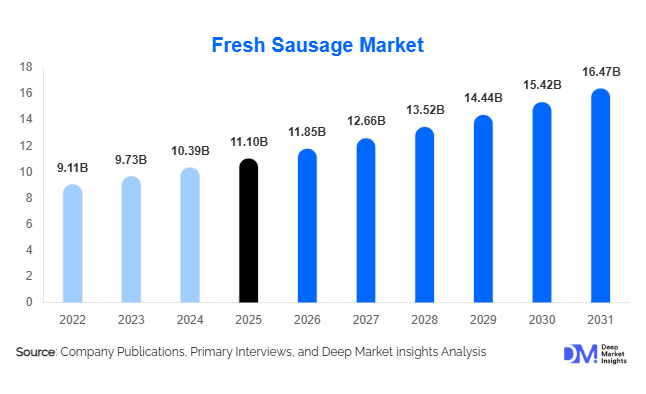
According to Deep Market Insights, the global fresh sausage market size was valued at approximately USD 11.1 billion in 2025 and is projected to grow from USD 11.85 billion in 2026 to reach USD 16.47 billion by 2031, expanding at a CAGR of 6.8% during the forecast period (2026–2031). The fresh sausage market growth is primarily driven by rising global protein consumption, increasing demand for convenient ready-to-cook meat products, expanding cold-chain infrastructure, and growing consumer preference for fresh, minimally processed meat products. Premiumization trends, clean-label formulations, and increasing foodservice utilization are further supporting market expansion across both developed and emerging economies.
Key Market Insights
- Pork-based fresh sausages remain the largest product category, accounting for nearly 46% of global market revenue due to strong consumer acceptance and cost competitiveness.
- Premium and artisanal fresh sausage products are gaining significant momentum, supported by growing demand for natural ingredients, organic meat sourcing, and gourmet flavor profiles.
- North America dominates the global fresh sausage market, driven by high per-capita meat consumption, extensive retail distribution networks, and strong foodservice demand.
- Asia-Pacific is the fastest-growing regional market, supported by urbanization, rising disposable income, expanding cold-chain infrastructure, and increasing adoption of Western dietary habits.
- Foodservice channels are becoming increasingly important demand generators, particularly quick-service restaurants, casual dining chains, and institutional catering providers.
- Advanced packaging technologies, including vacuum packaging and modified atmosphere packaging (MAP), are extending product shelf life and enabling broader market penetration.
Fresh Sausage Market Latest Trends
Premium and Clean-Label Sausages Driving Consumer Demand
Consumer preferences are increasingly shifting toward premium fresh sausage products formulated with natural ingredients, antibiotic-free meat, and transparent sourcing practices. Clean-label products free from artificial preservatives, nitrates, and synthetic additives are gaining shelf space across major retail channels. Manufacturers are introducing premium product lines featuring organic pork, grass-fed beef, heritage breeds, and region-specific seasonings to capitalize on evolving consumer expectations. This trend is particularly pronounced in North America and Europe, where consumers are willing to pay premium prices for perceived quality, freshness, and sustainability attributes. The growing popularity of artisanal butcher-style sausages and locally sourced meat products is further enhancing value growth within the market.
Expansion of Advanced Packaging and Cold-Chain Technologies
Packaging innovation continues to reshape the fresh sausage industry. Vacuum packaging, skin packaging, and modified atmosphere packaging technologies are helping manufacturers improve product shelf life, reduce spoilage, and maintain freshness throughout distribution. Simultaneously, investments in refrigerated logistics, temperature-controlled warehousing, and retail refrigeration systems are enabling deeper market penetration across emerging economies. These developments are particularly significant in Asia-Pacific and Latin America, where modern retail expansion is creating new opportunities for fresh meat product manufacturers. Enhanced traceability technologies and digital supply-chain monitoring are also improving food safety compliance and consumer confidence.
Fresh Sausage Market Drivers
Growing Demand for Convenient Protein Products
Modern consumers increasingly seek convenient meal solutions that require minimal preparation while delivering nutritional value and taste. Fresh sausages offer versatility across breakfast, lunch, dinner, and snacking applications, making them highly attractive for time-constrained households. Rising workforce participation, urbanization, and changing lifestyle patterns continue to support demand for ready-to-cook protein products. Fresh sausages are benefiting from this trend due to their ease of preparation, portion control advantages, and compatibility with various cuisines.
Increasing Premiumization Across the Meat Industry
The global meat industry is experiencing a significant premiumization trend as consumers become more willing to spend on higher-quality protein products. Premium fresh sausages featuring specialty meats, gourmet seasonings, organic ingredients, and sustainable sourcing practices are generating higher margins and driving market value growth. Manufacturers are leveraging premium positioning strategies to differentiate their products and capture affluent consumer segments seeking authenticity, traceability, and superior flavor experiences.
Expansion of Foodservice and Quick-Service Restaurant Demand
Fresh sausages are increasingly utilized across foodservice channels, including restaurants, quick-service chains, hotels, and institutional catering operations. Breakfast sandwiches, gourmet burgers, pizzas, and specialty menu items frequently incorporate sausage products, creating sustained demand from commercial buyers. Global expansion of organized foodservice establishments and increasing consumption of away-from-home meals continue to support volume growth within the fresh sausage market.
Fresh Sausage Market Restraints
Volatility in Livestock and Feed Prices
Fresh sausage manufacturers remain highly exposed to fluctuations in pork, beef, poultry, and feed prices. Livestock diseases, weather-related disruptions, geopolitical uncertainties, and feed grain shortages can significantly impact production costs. Since raw materials account for a substantial portion of overall manufacturing expenses, sustained volatility can compress margins and create pricing challenges across the value chain.
Health and Sustainability Concerns
Growing consumer awareness regarding processed meat consumption, sodium intake, environmental sustainability, and animal welfare is creating challenges for industry participants. Regulatory scrutiny surrounding meat processing practices and nutritional labeling requirements continues to increase globally. Manufacturers must invest in healthier formulations, reduced-sodium products, and sustainable sourcing initiatives to address evolving consumer expectations and regulatory requirements.
Fresh Sausage Industry Key Opportunities
Emerging Market Expansion Across Asia-Pacific
Asia-Pacific presents one of the largest growth opportunities for fresh sausage manufacturers. Rising disposable income, urbanization, growing retail modernization, and increasing adoption of Western food habits are driving demand across China, India, Indonesia, Vietnam, and the Philippines. Market penetration remains relatively low compared to North America and Europe, providing significant headroom for future growth. Companies investing in localized production and region-specific flavor development are expected to achieve substantial competitive advantages.
Foodservice Customization and Strategic Partnerships
Partnerships with quick-service restaurants, hotel chains, institutional caterers, and foodservice distributors present attractive growth opportunities. Customized sausage formulations designed specifically for commercial kitchens can create long-term supply relationships and recurring revenue streams. Foodservice operators increasingly seek differentiated protein products that enhance menu innovation and consumer appeal, creating opportunities for manufacturers to develop proprietary offerings.
Meat Source Insights
Pork fresh sausages continue to dominate the global market, accounting for approximately 46% of total revenue in 2025. Their leadership is primarily driven by strong cultural integration across European and Asian cuisines, wide availability of raw materials, and favorable cost efficiency compared to alternative meat sources such as beef and lamb. In addition, pork’s adaptability to diverse seasoning profiles and processing techniques has reinforced its position across both mass-market and premium offerings. Beef fresh sausages remain the second-largest category, supported by premium positioning, strong flavor profiles, and sustained demand across North American and select European markets where beef consumption is deeply embedded in culinary traditions. Poultry-based fresh sausages, particularly chicken and turkey variants, are witnessing the fastest growth, driven by rising health consciousness, increasing preference for lean protein diets, and growing alignment with calorie-conscious and wellness-oriented consumption trends. Lamb and mixed-meat sausages maintain stable, regionally concentrated demand, particularly in the Middle East, parts of Europe, and niche gourmet segments where distinctive flavor profiles are valued. Plant-based fresh sausage alternatives, while still emerging, are expanding rapidly due to sustainability concerns, flexitarian dietary shifts, and continuous product innovation aimed at improving taste and texture parity with conventional meat-based sausages.
Product Format Insights
Linked fresh sausages hold the largest share at approximately 43% of global market revenue, supported by their standardized portioning, strong retail visibility, and ease of cooking across household and foodservice applications. Their dominance is further reinforced by efficient packaging formats that improve shelf presentation and extend refrigerated stability, making them highly attractive to large-scale retailers and distributors. Patties are gaining momentum, particularly in breakfast menus and quick-service restaurant applications, where convenience, speed of preparation, and portion consistency are key purchasing drivers. Bulk and loose fresh sausage formats remain essential within culinary preparation environments, including stuffing, catering, and processed food manufacturing, where flexibility and ingredient integration are critical. Coiled sausages continue to demonstrate sustained popularity in European and Latin American markets, driven by traditional culinary practices and strong regional identity associated with artisanal meat preparation. Skinless fresh sausages are emerging as a convenience-driven innovation, increasingly favored in modern urban households and ready-to-cook applications where ease of handling and reduced preparation time are primary consumer considerations.
Distribution Channel Insights
Supermarkets and hypermarkets dominate the distribution landscape, accounting for approximately 54% of global fresh sausage sales, primarily due to their extensive refrigerated infrastructure, wide product assortment, and high consumer footfall. Their leadership is further strengthened by private-label expansion strategies and strong promotional pricing structures that increase consumer accessibility. Specialty meat stores and butcher shops maintain a strong foothold in premium and artisanal segments, where consumers prioritize product origin, craftsmanship, and customized cuts. Convenience stores play an increasingly important role in dense urban environments, supported by on-the-go consumption trends and shorter purchase cycles. Online retail channels are expanding rapidly, driven by advancements in cold-chain logistics, improved last-mile delivery systems, and rising consumer comfort with purchasing perishable goods digitally. Direct-to-foodservice distribution continues to serve as a critical backbone for manufacturers, enabling efficient bulk supply to restaurants, hotels, and institutional buyers, where consistency, reliability, and cost optimization are key procurement drivers.
End-User Insights
Household consumers account for approximately 51% of global fresh sausage demand, supported by the product’s versatility across multiple meal occasions, ease of preparation, and compatibility with both traditional and modern recipes. This segment is further driven by growing demand for convenient protein sources that align with busy urban lifestyles. Foodservice operators represent the fastest-growing end-user category, fueled by increasing restaurant penetration, continuous menu innovation, and rising demand for protein-rich offerings across diverse cuisines. Quick-service restaurants are significantly expanding the use of fresh sausages in breakfast menus, sandwiches, and hybrid fast-food products, driven by consumer preference for quick, flavorful, and high-protein meals. Institutional foodservice providers, including schools, hospitals, and corporate cafeterias, contribute stable and predictable demand through long-term procurement contracts, where cost efficiency, nutritional compliance, and scalability are primary purchasing considerations.
Price Positioning Insights
Mid-range fresh sausage products dominate global consumption due to their optimal balance between affordability and perceived quality, making them accessible to a broad consumer base across both developed and emerging markets. This segment benefits from strong retail penetration and consistent demand across household and foodservice channels. Economy-priced products maintain significant traction in price-sensitive markets, particularly in developing economies where affordability remains the primary purchasing driver. Premium fresh sausages are expanding at a faster pace than the overall market, supported by rising consumer interest in clean-label ingredients, organic certifications, specialty meats, and gourmet flavor profiles. Artisanal and gourmet sausages, while occupying a smaller share of total volume, generate disproportionately high margins, driven by strong branding, craftsmanship positioning, and demand from high-income consumers seeking differentiated culinary experiences.
| By Meat Source | By Product Format | By Flavor Profile | By Packaging Type | By Distribution Channel |
|---|---|---|---|---|
|
|
|
|
|
Regional Insights
North America
North America accounted for approximately 34% of global fresh sausage market revenue in 2025, making it the largest regional market. Growth in this region is primarily driven by deeply embedded meat consumption habits, strong barbecue and grilling culture, and widespread integration of sausages into breakfast and fast-food applications. The United States leads regional demand, supported by a highly developed foodservice sector, strong retail penetration, and continuous product innovation focused on clean-label, organic, and high-protein offerings. Canada contributes steady demand for premium and specialty sausage products, supported by increasing health awareness and multicultural dietary influences. Mexico is experiencing rising consumption driven by expanding modern retail infrastructure, urbanization, and growing middle-class purchasing power. Across the region, premiumization trends and innovation in flavor profiles, coupled with strong demand from quick-service restaurants, continue to serve as key growth accelerators.
Europe
Europe represents approximately 31% of global market revenue and remains one of the most mature and structurally diverse fresh sausage markets. Growth is primarily supported by long-standing culinary traditions, strong regional sausage varieties, and high consumer familiarity with processed meat products. Germany, Italy, Spain, France, Poland, and the United Kingdom collectively drive regional consumption, with Germany playing a particularly dominant role due to its deep-rooted sausage culture and extensive product diversification. The region’s growth is strongly influenced by premiumization and artisanal product demand, especially in Western Europe, where consumers increasingly value traceability, craftsmanship, and organic certifications. Central and Eastern Europe contribute significant volume growth, supported by affordability-driven consumption and strong domestic production capabilities. Regulatory emphasis on food quality and labeling transparency further reinforces consumer trust and sustains stable market expansion.
Asia-Pacific
Asia-Pacific accounted for approximately 22% of global market revenue in 2025 and represents the fastest-growing regional market, with a projected CAGR exceeding 8% through 2031. This rapid expansion is primarily driven by accelerating urbanization, rising disposable incomes, and increasing exposure to Western dietary patterns. China remains the largest consumer market in the region, supported by expanding refrigerated retail infrastructure and growing demand for convenient protein options among urban households. India is expected to be the fastest-growing market globally, driven by modern retail development, increasing acceptance of processed meat products in urban centers, and expansion of quick-service restaurant chains. Japan, South Korea, and Australia continue to demonstrate strong demand for premium, high-quality, and specialty sausage products, supported by sophisticated consumer preferences and strong foodservice ecosystems. Cold-chain logistics improvements and rapid e-commerce penetration are further enabling market expansion across both metropolitan and tier-2 cities.
Latin America
Latin America accounts for approximately 8% of global market revenue, with Brazil, Argentina, Chile, and Colombia serving as the primary demand centers. Growth in the region is strongly supported by abundant livestock production, cost-efficient raw material availability, and established meat consumption traditions. Brazil plays a dual role as both a major producer and consumer, benefiting from its large-scale agricultural base and strong domestic demand. Market expansion is further supported by urbanization trends, rising middle-class income levels, and ongoing modernization of retail infrastructure, which improves product accessibility across urban and semi-urban areas. While economy and mid-range products dominate consumption, premium sausage categories are gradually gaining traction as consumers become more receptive to differentiated and higher-quality meat offerings.
Middle East & Africa
The Middle East & Africa region accounts for approximately 5% of global market revenue, with key demand centers including Saudi Arabia, the United Arab Emirates, South Africa, Egypt, and Morocco. Market growth is primarily driven by expanding tourism industries, rapid development of the hospitality sector, and increasing investments in modern food retail infrastructure. Urbanization and rising disposable incomes are contributing to gradual adoption of fresh sausage products, particularly in metropolitan areas with diverse expatriate populations. The region also benefits from increasing imports and improved cold-chain distribution systems, which enhance product availability and quality consistency. Growth is further supported by demographic expansion and evolving dietary patterns influenced by global cuisine trends, especially within the foodservice and hotel sectors.
| North America | Europe | APAC | Middle East and Africa | LATAM |
|---|---|---|---|---|
|
|
|
|
|
Key Players in the Fresh Sausage Market
- Tyson Foods
- Smithfield Foods
- Hormel Foods
- JBS
- Cargill
- OSI Group
- Danish Crown
- Tönnies Group
- Vion Food Group
- Cranswick
- Clemens Food Group
- Johnsonville
- Premium Brands Holdings
- Atria Plc
- HKFoods